Hoopla Update 3
The Poitin Makers Child…
Unfortunatly I hit a bit of a snag when it came to making the paint itself. When I made the pigments I really struggled with making the red and it turns out this is the same issue when I turned it into paint. No matter what I added it turned brown. This unfortunatly happened when I tried the pink as well.
Another issue I found is that the colours came out really dark. The blue under a lot of lights just looks black. I tried to lighten the blue using a bit of lemon juice, which kind of worked but instead turned it purple. I ended up using this pruple for one of my paints, however it did darken a lot when dry. I wanted to see if I could lighten any of the paints by using chalk or white charcoal. Unfortunatly I wasn’t able to get hold of any natural chalk in time but I managed to get which charcoal. When testing I couldn’t get the white to mix with the other pigments but instead I did end up using it as a paint itself!
Yellow paint was really easy to make as the turmeric made a beautiful yellow and painted really well. I also mixed the blue pigment with the turmeric and this made a stunning green, probably my favourite one!
Finally it is ready as much as it can be before the exhibiton on Thursday! I installed it Monday as well as helping set up the walls, fill, and paint them. The last edition I made for the exhibition was adding a scoreboard on a plinth next to the hoopla set so people can keep track of their scores!
Hoopla Update 2
The Poitin Makers Child…
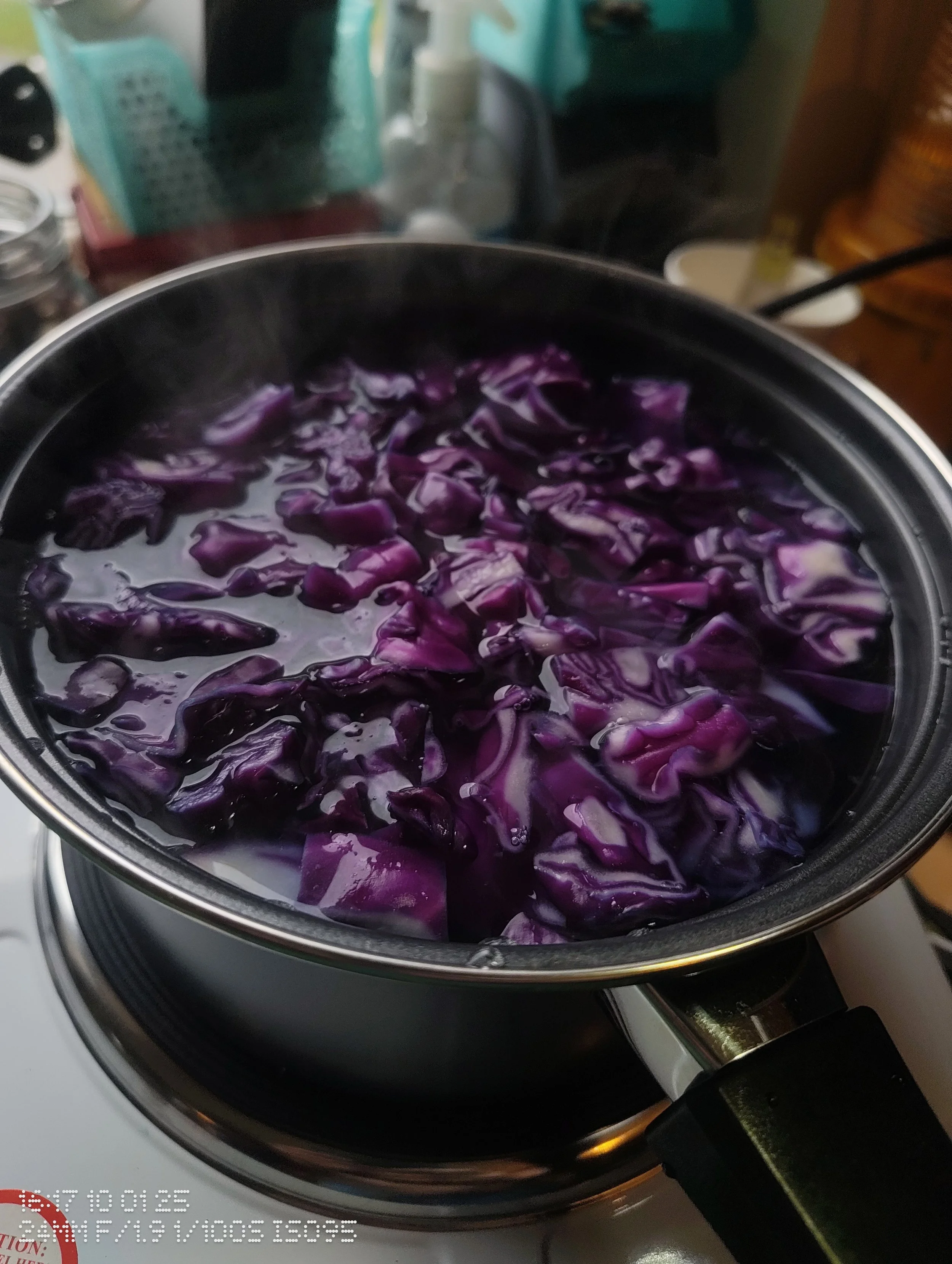
Back again with the Hoopla set, this time I’ve been working on the paints. It’s taking a lot of trial and error but I’ve managed to make some of the pigment powders I’ll need to make into paint. The first one I tried to work on was blue pigment, to do this I used red cabbage and boiled it for an hour until the water was a really strong purple. I then strained this into a jar and while it was still warm I added xanthan gum and alum powder to make it throth into a thicker foam and leave it to settle over night. The next day I then strained it through some muslin cloth and let it dry for a week until it was solid and I could turn it into powder.
Unfortunatley beetroots weren’t as easy to get a good colour from as red cabbage. With a bit of experementation I found that I needed to add a bit of vinegar and change the ratio of xanthan gum and alum powder or it would just become brown.
The third colour I made was pink, which surprisingly enough comes from avocado! Using the stones from an avocado I was able to follow the same process as red cabbage and was able to make a pink!
The last 2 colours to make are yellow and green. I intend to use turmeric for the yellow and as that is already purchasable as a powder that one is easy. The green I’ve heard can be a bit of a challege, either using nettles or spiniach. As it is getting closer to the deadline for the exhibition I’m intending to test if I can combine the yellow and blue to make a green.
Hoopla Update
The Poitin Makers Child…
Though only made a few months ago, the hoopla set is getting an update.
I was informed of an exhibiton at NTU for technicians, to show some of the art that we make. I really wanted to submit to this exhibition and thought the Hoopla set would be a great tactile piece for it. I would like to make some changes though.
The main reason I made this was to get away from using plastics in favour of more natural materials. In doing so I neglected the fact that I had used acrylic paint, and a synthetic embroidery thread. This is something I wanted to change.
Making thread and natural paints are 2 things I’ve never done before. After a bit of research I found that I could make some nettle cordage, and use vegetables to create dyes that I could then turn into pigment powder and make into paint.
I started with the nettle cord as it was a lot easier to get my head around. I visited the arbouretum with a pair of scissors, a big bag, and some gloves and cut a lot of nettles at the base. This had to be brought home and processed before it all dried out. All the nettle leaves were removed from the stem, and I crushed the stem using a mini anvil I have and an old iron. The gloves had to then be removed so I could half the stem along it’s length and remove the inners. Each of these fibres needed to dry over night before I could twist it into cord.
All these individual fibres were twisted together to create a long length. I’m still going with this as I have a lot of cordage to make. It’s a fun process, if not a bit itchy!

The Poitin Makers Child
The Poitin Makers Child…
Poitin Makers Child was such a fun show to work on, with such an amazing team at its back. Even though I haven’t been with the project since its original scratch night the team welcomed me with open arms and made me feel like I’d been working with them for years. This show was the first time I felt confident as a designer and the team helped me realise I don’t need to constantly ask opinions from other people and be confident in my own work and ideas.
We had a recent NTU graduate with us for the rehearsals and one of the show days (Lauren) and she was such a joy to work with. Though we brought her on board to shadow and learn from the Stage Manager (Ali) she also gave me a hand with a few design jobs such as painting and made a few pom-poms for the crochet moss I made.
As soon as I was given the video of the scratch night and a general idea of the show my mind was flooded with ideas for set pieces. I was largely inspired by wishing trees in Ireland, filled with ribbons and knick-knacks hanging above the stage. I’m already very inspired by folklore and mythology of the British Isles and meant that I already owned a lot of the props that could be hung from the tree or placed on the fireplace.
The biggest challenge for the show was the mossy concept I wanted to have. I imagined a mossy floor and set pieces laden with moss. The best way I could think to do this was to crochet! A total of 20 balls of fluffy green wool were used to create patches of moss that were either scattered around the floor or attatched to the set. This was then textured with paint to add a dirty mud effect to pieces.


Hoopla
The Poitin Makers Child…
Every year I work with City Arts Nottingham on their Hoopla project, a free festival for 0-4 around Nottingham parks. In our previous years I always lemented over the fact we had 1 hoopla set and it was not very hardy plastic. I think there is a real benefit to children playing with wooden toys over plastics, they’re a lot more robust and I feel like they’re very grounding. Our connection with nature and natural materials is really important to me. Because of this I promised Alison (the organiser of this event) that I’d make a wooden hoopla set!
I bought some white oak planks, and found some sapele in a nearby skip and from there started the project. I cut half lap joints into the oak planks to create a cross. These planks weren’t very square and I wanted to keep it that way, liking the idea of a rustic non-perfect item.
Next came turning the pegs on the lathe. The second that I turned my lathe on and the wood started to spin, the cheap lathe I’d bought over a year before conked out. This lead to be purchasing a much higher quality lathe that I still had to repair myself (thank you clumsy delivery drivers). With the new lathe now frankensteined together I could get back to turning the pegs. I cut in grooves on the pegs that I could add paint to.
I added 5 colours of paint, 1 colour for each peg. And then used a pyrography pen to burn in numbers on the oak next to each peg. This being for 0-4 children I thought I’d keep it simple and instead number them 1-5 as opposed to the traditional 5, 10, 15, 20, and 25. (It was also much more simple for me to write!)
Finally I made the quoits. I used rope that Alison had given me, rope that she’d had since her university days (and nearly the same age as me!) I wove this rope into quoits and used embroidery thread to finish off the join.


